Danuri Call Center : 1577-1366
Family consultation call: 1644-6621


21F, 173, Toegye-ro, Jung-gu, Seoul (Chungmuro 3-ga, Namsan Square Building)
Copyright ⓒ KOREA INSTITUTE FOR HEALTHY FAMILY. All Rights Reserved
The story of our children’s life at child care center
- Home
- Life plus
- The story of our children’s life at child care center
The story of our children’s life at child care center
01What is child care center?
A child care center is:
This is an educational and childcare institution operating under the Child Care Act for the childcare of infants and young children with authorization from the city mayor, county governor, or the head of a gu.
Eligibility
Childcare Centers care for pre-school children aged seven and under. However, if needed (such as for disability integration or after-school education), childcare can be provided up to age 12.
Operating hours
The child care center is basically operated for 12 hours during weekdays (7:30a.m.~7:30p.m.) and for 8 hours on Saturdays (7:30a.m.~3:30p.m.). However, by considering the main guardian’s working hours and after getting consent from the guardian beforehand, the operation of each child care center can be adjusted. (The operation of night-time extended daycare and holiday child care).
Care hours of the child care center
The operating hours of the child care center are classified into basic care (9 a.m.~4 p.m.) which is applied to all infants and preschool children and additional care (4 p.m.~7:30 p.m.) which is applied to infants and preschool children who need additional care. For extended care hours, additional teachers are assigned.
- 1Counseling on the use of extended care (Director ↔ parents) (Desired hours of extended child care)
- 2Application for the qualification of extended care (Applicable only to children aged 0~2)
- Infants aged 0~2 must satisfy a qualification of needing extended-hours care.
- Infants aged 3~5 can use extended care after a counseling with a child care center without needing to meet additional qualification.
- Infants aged 0~2 must satisfy a qualification of needing extended-hours care.
- 3Application for the use of extended care (All children aged 0~5)
- 4Confirm the use of extended care
02What kind of child care center is good?
Operations policy & childcare philosophy
Each child care center has a basic operations policy or care philosophy. In particular, the operations policy, care philosophy and attitude of the director of a child care center, who is in charge of the center, can have a great influence on the center, so please check these aspects beforehand via the homepage of the center for a consultation with the director.
Standard childcare curriculum
The standard childcare curriculum follows the goals and content of universal and common childcare provided at the national level for infants and young children aged zero to five in childcare centers. It consists of childcare curriculum for ages zero to one, two, and three to five (Nuri Curriculum). ※ What is the Nuri Curriculum for ages three to five? It is a common curriculum for childcare and education that guarantees high-quality and equal educational opportunities from the first starting line of life, regardless of whether the child attends a childcare center or kindergarten.
The ratio of teachers vs. infants and preschool children
The ratio of teachers vs. infants and preschool children is the most basic environmental condition that is needed for a teacher to identify individual characteristics of children and to provide proper care. The current legal ratios of teachers vs. infants and preschool children notified by the government are as follows:
| Age (year old) | 0 | 1 | 2 | 3 | 4 or older |
|---|---|---|---|---|---|
| Standard of assignment | 1:3 | 1:5 | 1:7 | 1:15 | 1:20 |
Safety and cleanliness of indoor/ outdoor environment
Infants and preschool children who engage in exploration actively due to high curiosity are likely to be exposed to safety hazard accidents and have low resistance to diseases, so the safety and cleanliness of the indoor and outdoor facilities of a child care center should be examined thoroughly.
Schedule operation suitable for the development of infants and preschool children
Daily schedule must be operated to be suitable for the daily life patterns of children, so the schedule should allow for enough play time, proper rest, napping, and indoor activities according to the development of infants and preschool children.
Balanced meals
During infancy and preschool childhood, children go through rapid growth, so it should be checked whether a child care center provides balanced meals and snack for the nourishment needed for growth of children and major food ingredient suppliers and country of origin should be checked as well.
Distance from home
Even if a child care center is excellent, if it is located far from home, commuting the child care center can be too hard for children, so it is important to choose a child care center close to home.
03What to prepare before being admitted to a child care center?
Admission application for a child care center
Guardians who want to use a child care center can apply for admission online without time and place constraints.
- Registration time for admission: allowed year-round
- Number of childcare centers you can enroll in on the admission waiting list: A child can be on the waiting list of three centers, whether or not he or she is already enrolled at a childcare center (including children enrolled in childcare centers scheduled for closure).
- Age range eligible to be on the waiting list: Ages 0 to 5 (However, children with disabilities are eligible up to age 12)
- Applicable childcare centers: Can be on the waiting list of all childcare centers which have admission priority (excluding workplace and cooperative childcare centers)
- Application Methods
- In the case of foreign national children, application via the general portal is not possible. Please make a request to a child care center you wish to be admitted or to a local government where a child care center is located
- 1Child registrationAfter joining in membership on the Child Care portal, register your child to be admitted
- 2Search for a child care centerAfter searching child care centers, choose one center
- 3Reservation applicationApplication for admission to a child care center
- 4Confirm children to be admittedChild care centers confirm children to be admitted after checking the wait-listed order according to the level of priority
- 5Submit materials related to the level of priority admissionChild care centers acquire and review documents related to admission from parents, except automatic qualifications
- 6Process the admission of childrenChild care center processes the admission of children according to the order of wait-listed admission
Application for Citizen Happiness Card
The government provides Child care center subsidy in the form of a voucher. Accordingly, if you decided to send your child to a child care center, you must apply for the issuance of Citizen Happiness Card.
- With Citizen Happiness Card, you can use various support provided by the government such as day care fees, early child education fees, national health insurance coverage for pregnancy and child delivery, as well as e-vouchers for social services.
| Online | Offline | ||
|---|---|---|---|
| Application for subsidy | When you apply for government subsidy, you can get an approval for day care fees & kindergarten education fees. | Application for subsidy | When you apply for government subsidy, you can get an approval for day care fees & kindergarten education fees. |
| Subsidy application form | Homepage of Bokjiro(www.bokjiro.go.kr) | Subsidy application form | township (eup/myeon)/dong community center |
| Card issuance | Select your favorite card company from five card companies and get a credit card. (No annual membership charge) | Card issuance | Select your favorite card company from five card companies and get a credit card. (No annual membership charge) |
| Card issuer | Homepage of Bokjiro(www.bokjiro.go.kr) | Card issuer | township (eup/ myeon)/ local (dong) community center, major card company branches nationwide |
| Child Care, the general portal of pregnancy & child care (www.childcare.go.kr) | |||
| Homepage of five credit card companies (KB Kookmin Card, Shinhan Card, Lotte Card, Samsung Card, BC Card) | |||
Orientation for newly admitted children & admission documents
Orientation for newly admitted children provides information on the current condition and operations policy, childcare programs and each class-related operations policy of a child care center. It is a great opportunity to get detailed information, so we strongly recommend attending the orientation, where you will get a guideline on admission documents. Most of the documents are required by the government, so you must submit them at a specified time by preparing them beforehand.
Preparation materials for child care center
Preparation materials for child care center may vary by child care center. In general, the materials are needed for your child’s life at a child care center. They include a comforter for naps, a pillow, toothbrush, toothpaste, wet tissues, and others. For infants/ toddlers, milk powder, milk bottle and a gauze towel can be included as personal supplies.
Mindset preparation
Parents who send their child to a child care center for the first time may feel anxious and a sense of guilt for their child(ren), rather than positive expectations. However, this kind of parents’ mindset can have a negative influence on their child’s adaptation, so they need to visit their child care center with their child and talk with the teacher or have a regular life routine according to the child care center’s schedule to be mentally prepared. In the case of dual-career families, they may need to participate in the adaptation period by adjusting their vacation after checking the child care center’s adaptation period or by looking for grandparents who will provide a help.
04How to help your child who goes to a child care center for the first time?
What is a child care center adaptation program?
Child care center adaptation program allows children to acclimate/ adjust to a child care center’s schedule gradually over time when they are first admitted to a child care center to overcome anxiety about an unfamiliar environment and be able to adapt to a new environment. The adaptation program extends time, starting from ‘a participation into a morning schedule’ with parents and to ‘lunch time’, ‘nap time’ and participation in an afternoon schedule.’ Separation from parents will begin for 5~10 minutes and will be extended gradually. This process will be operated systematically over a week at least at the discretion of the parents and teachers, and will be operated flexibly according to the environment of a child care center, as well as the individual characteristics of infants and preschool children and the environment of each family.
Children’s behaviors that can appear during an adaptation period
The experience of being left alone at an unfamiliar child care center after being separated from parents can be very hard on a child, and children may express their anxiety in various ways. Accordingly, parents should embrace their children’s anxious mind and help them with an appropriate method.
- Children may cry continuously as they step in a child care center and say negative talks.
- Children may say they feel sick around the time of going to the child care center even if there is no special physical symptoms.
- Children may refuse teachers or do not react to teachers.
- They may refuse meals or snack provided by the child care center.
- They may look for their parents as they cry excessively during nap time.
- They may seek out affection excessively to parents or whine often.
- Children may have accidental bowel movements all of a sudden, look for a milk bottle, or suckle their finger.
- Parents should believe that their child will adapt to a child care center well.
- Parents should express that a child care center is a trustworthy place and teachers are kind in front of their child.
- Parents should not be disturbed by their child’s nervous symptoms which can appear during the adaptation period and console their child who goes to their child care center.
- Parents should maintain the routine schedule of going to and leaving a child care center as much as possible, and pick up their children on time from a child care center.
- Parents should not leave their child(ren) without their knowledge or tell a lie to their child(ren) (“I need to go to the restroom!”) when separating from their child(ren).
- Parents should understand that adaptation time varies by each child and should wait patiently.
- Parents should share their child’s reactions and behavioral change processes observed during the adaptation period with teachers through a conversation note and a notice notebook.
- As several children interact in a child care center, children can be vulnerable to viral diseases so parents need to maintain their child’s good health and pay attention to their child’s personal hygiene.
- By talking about positive episodes of a child care center, rather than focusing on negative ones, parents should instill a positive attitude in their child(ren). If parents focus on their child(ren)’s distressed episodes at a child care center, negative attitudes about the child care center can take over the child(ren’s) attitude about going to day care.
05How do children spend time at a child care center?
- 1Going to the center

- 2Morning snack

- 3Morning indoor activities

- 4Outdoor activities

- 5Lunch time
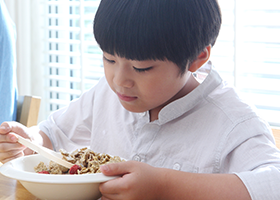
- 6Brushing teeth & going to the restroom

- 7Taking a nap

- 8Afternoon snack

- 9Afternoon indoor activities

- 10Going back home